
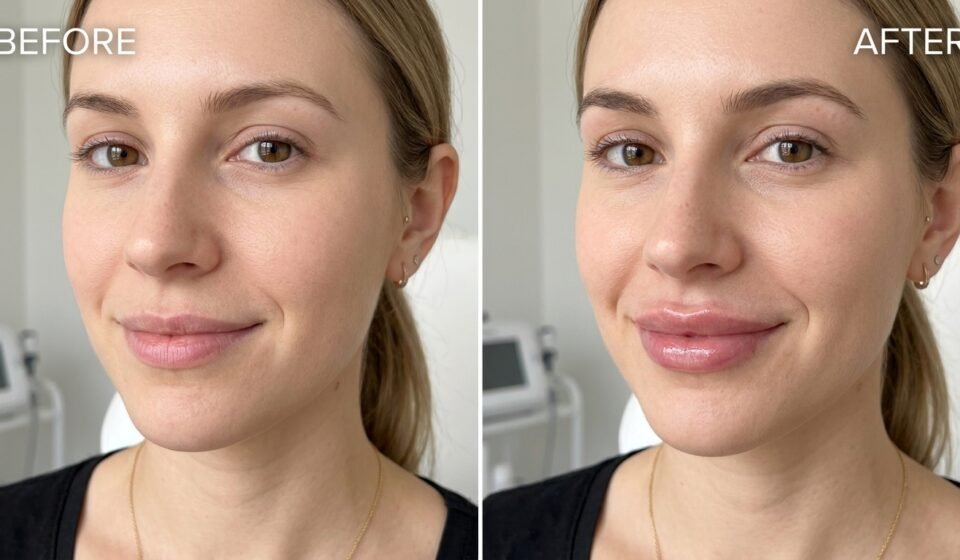

Lip filler before and after photos are one of the most searched resources for people considering lip augmentation. They can help you understand changes in lip volume, shape, symmetry, definition, and overall facial balance before deciding whether treatment is right for you.
Lip filler is a type of dermal filler designed to increase lip fullness. Many commonly used lip fillers contain hyaluronic acid, a substance that is naturally found in the body. Results can look subtle or more noticeable depending on the product, amount used, injection technique, and the individual’s natural lip structure.
Before-and-after photographs can be useful, but they should not be treated as a guarantee of your own results. Every person’s anatomy, treatment plan, healing process, and response to filler is different.
This complete guide covers lip filler before and after results, swelling, healing time, one-week and two-week changes, expected appearance, common side effects, longevity, and important safety considerations.
Medical note: Lip filler is a medical procedure. Always consult a qualified, licensed healthcare professional experienced in dermal filler injections before treatment.
Lip Filler Before and After: Quick Overview
The appearance of lips immediately after filler is often different from the final healed result.
| Stage | Typical Appearance |
|---|---|
| Before treatment | Natural lip shape and volume |
| Immediately after | Fuller lips with possible swelling and redness |
| First 24–48 hours | Swelling and tenderness may be noticeable |
| Around 1 week | Swelling generally begins settling |
| Around 2 weeks | Results are easier to evaluate |
| Later follow-up | Provider can assess symmetry and final appearance |
The exact timeline varies from person to person. Cleveland Clinic notes that swelling commonly improves within 24–48 hours but can sometimes take up to a week. A follow-up around two weeks may be used to assess the result.
What Is Lip Filler?
Lip filler is a dermal filler injected into specific areas of the lips to increase fullness or improve lip contours.
Many lip fillers use hyaluronic acid (HA). HA occurs naturally in the body and can hold water, helping create a fuller appearance when formulated as a dermal filler.
Depending on the treatment plan, filler may be used to enhance:
- Upper-lip volume
- Lower-lip volume
- Lip border definition
- Cupid’s bow
- Lip symmetry
- Overall lip proportions
- Appearance of age-related volume loss
The goal does not always have to be dramatically larger lips. Some people seek a subtle enhancement that maintains their existing facial proportions.
Lip Filler Before and After: What Changes Can You See?
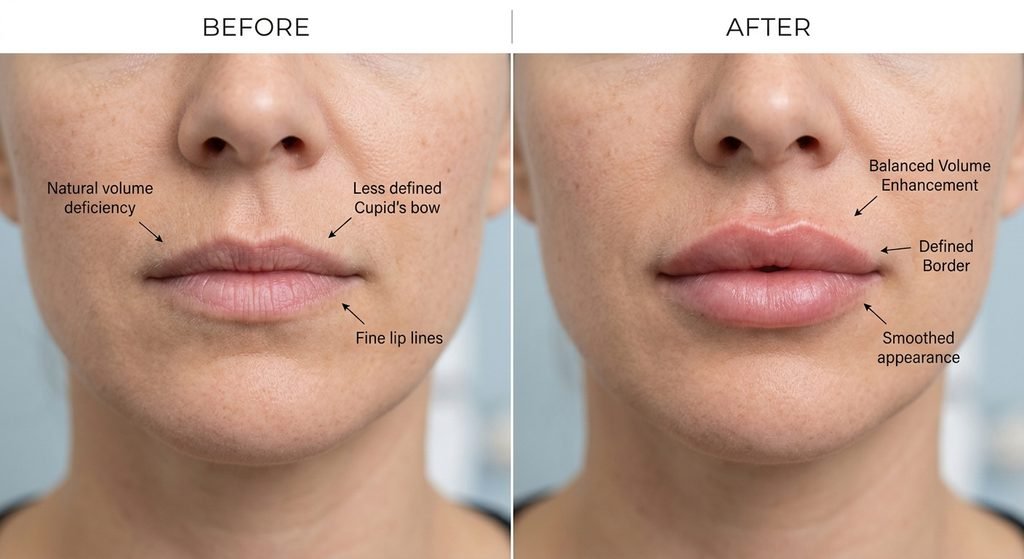
A well-planned lip filler treatment can create visible differences in several areas.
Increased Lip Volume
The most obvious change is usually increased fullness.
Thin or naturally less-full lips may appear more pronounced after treatment. The amount of enhancement depends on the treatment plan and the amount of filler used.
More Defined Lip Border
Some treatments emphasize the vermilion border, which is the transition between the colored portion of the lips and surrounding skin.
This can make the outline of the lips appear more defined.
Improved Symmetry
Natural lips are rarely perfectly symmetrical. Carefully placed filler may be used to address certain differences between the upper and lower lips or between the left and right sides.
More Defined Cupid’s Bow
The Cupid’s bow is the curved shape at the center of the upper lip. Strategic treatment can sometimes make this area appear more defined.
Softer Appearance Around the Mouth
Dermal fillers may also be used for certain lines around the mouth, depending on the product and approved indication.
The FDA states that approved dermal fillers can be used for specific facial indications, including increasing lip fullness in adults 22 and older.
Lip Filler Before and After: Immediate Results
One reason lip filler is popular is that an increase in volume can often be seen immediately after injection.
However, the first result is not necessarily the final result.
Right after treatment, lips may appear:
- Larger than expected
- Swollen
- Slightly uneven
- Red
- Tender
- Bruised
- Firm in certain areas
This can make it difficult to judge the final outcome immediately.
Cleveland Clinic reports that swelling and sensitivity are common after lip filler and may take several days to settle.
Lip Filler Before and After 24 Hours
During the first 24 hours, swelling can make the lips look significantly fuller than the intended final result.
You may notice:
- Puffy lips
- Mild redness
- Tenderness
- Bruising
- Temporary unevenness
- Small areas of firmness
This early appearance should not automatically be interpreted as the final result.
Follow the specific aftercare instructions provided by your healthcare professional.
Lip Filler Before and After 3 Days
By approximately three days, some people notice that swelling has started to decrease.
The lips may begin looking more natural, although residual swelling or bruising can still be present.
At this point, avoid comparing your lips too closely with online photographs. Different lighting, camera angles, facial expressions, filler products, and healing stages can dramatically change the appearance of before-and-after images.
Lip Filler Before and After 1 Week
At around one week, much of the early swelling may have settled for many people.
The lips may begin to show:
- More natural volume
- Improved definition
- Better symmetry
- A softer appearance
- Less tenderness
However, some people may still have swelling or bruising.
A one-week photograph can be useful for documenting progress, but it may still be too early for some patients to judge the final outcome.
Lip Filler Before and After 2 Weeks
The two-week point is often more useful for evaluating the overall appearance.
By this stage, most of the initial swelling should have improved, although individual healing varies.
A healthcare provider may schedule a follow-up appointment around this time to evaluate the lips and determine whether any further treatment is appropriate.
At this stage, you can usually compare:
- Lip volume
- Shape
- Symmetry
- Border definition
- Upper-to-lower lip proportion
- Overall facial balance
Lip Filler Before and After 1 Month
A one-month comparison can provide an even clearer picture of the longer-term appearance.
Instead of focusing only on size, evaluate whether the treatment complements your natural facial features.
A successful-looking result does not necessarily mean the biggest possible lips. A conservative enhancement may appear more harmonious with the rest of the face.
The American Academy of Dermatology advises discussing desired results with a qualified professional and taking a conservative approach rather than overdoing filler.
Natural-Looking Lip Filler Before and After Results
The phrase natural-looking lip filler usually refers to enhancement that preserves the individual’s facial proportions rather than creating an exaggerated appearance.
A natural result may involve:
- Moderate volume
- Defined but not overly sharp borders
- Balanced upper and lower lips
- Preservation of natural lip movement
- Appropriate proportion with the chin, nose, and surrounding facial features
The amount of filler required is not the same for everyone.
Someone with naturally thin lips may need a different treatment plan from someone who already has substantial lip volume.
Lip Filler Before and After for Thin Lips
People with naturally thin lips may choose filler to create additional volume.
The goal should be discussed carefully with the injector because adding volume too quickly can produce an appearance that differs from the patient’s expectations.
A staged or conservative approach may be appropriate for some patients.
Lip Filler Before and After for Lip Asymmetry
Small differences between the two sides of the lips are common.
Filler may sometimes be strategically placed to improve the appearance of asymmetry.
However, perfect symmetry is not necessarily realistic, and the final result depends on individual anatomy and the amount of correction possible.
Lip Filler Before and After for Lip Lines
As people age, changes around the lips can include loss of volume and the development of fine lines.
Certain dermal fillers may be used for approved indications involving facial lines and folds. The appropriate treatment depends on the individual and the specific product.
Consult a qualified provider for an assessment rather than assuming that lip filler is the correct solution for every line around the mouth.
Lip Filler Before and After: Swelling vs. Final Results
One of the biggest mistakes people make when looking at lip filler photos is comparing an immediate post-treatment image with a fully healed photograph.
These are not equivalent stages.
| Appearance | Possible Explanation |
|---|---|
| Very large immediately after treatment | Temporary swelling |
| Mild redness | Injection-related reaction |
| Bruising | Common short-term effect |
| Slight unevenness | Swelling can be uneven |
| Firmer areas | Temporary tissue response |
| More balanced appearance later | Swelling has settled |
The FDA lists swelling, bruising, redness, pain, tenderness, itching, and rash among possible risks associated with dermal fillers.
How Long Does Lip Filler Last?
Lip filler is generally temporary.
The exact duration depends on the product, treatment area, amount used, individual metabolism, and other factors.
The American Academy of Dermatology lists hyaluronic acid filler as typically lasting around 4 to 12 months, although individual results can vary.
Some FDA-approved lip fillers have specific clinical data showing temporary effects over several months. For example, the FDA’s information on RHA 3 describes temporary lip augmentation and reports visible effects at different follow-up points in its clinical study.
Because different products have different properties, ask your provider about the specific filler being recommended.
Lip Filler Before and After: Factors That Affect Results
Many variables can influence the final appearance.
Filler Type
Different fillers have different characteristics, formulations, and approved uses.
Amount of Filler
More filler does not automatically mean a better result.
Injection Technique
Placement matters because different areas of the lips affect shape, projection, and definition.
Natural Lip Anatomy
The starting shape and volume of your lips influence the final appearance.
Healing
Swelling and bruising can temporarily change the appearance of the lips.
Individual Response
People can respond differently to the same type of treatment.
How to Choose Good Lip Filler Before and After Photos
Before-and-after photographs can be useful during a consultation, but they should be evaluated carefully.
Look for photographs that show:
- Similar starting lip shape
- Similar facial angle
- Similar lighting
- Similar facial expression
- Clear before and after dates
- Unedited images where possible
- Results from the same practitioner
- A range of patient outcomes
The American Academy of Dermatology specifically recommends asking to see before-and-after photographs of patients treated by the provider.
Why Social Media Lip Filler Photos Can Be Misleading
Online images may be affected by:
- Lighting
- Makeup
- Lip liner
- Camera angle
- Filters
- Facial expression
- Photo editing
- Different lenses
- Different healing stages
Therefore, social media photographs should not be used as a guarantee of what your own lips will look like.
Lip Filler Before and After: Questions to Ask at a Consultation
Before treatment, consider asking:
- Which filler are you recommending?
- Is the product approved for this specific use?
- How much filler do you recommend?
- What result should I realistically expect?
- What are the common side effects?
- What complications should I know about?
- How much experience do you have with lip injections?
- Can I see before-and-after photographs of your patients?
- How long should the result last?
- What should I do if I am unhappy with the result?
The AAD recommends discussing the filler, possible side effects, whether the product is FDA-approved for the intended use, provider experience, and before-and-after photographs during the consultation.
Lip Filler Safety: Important Things to Know
Although dermal fillers are widely used, they are still medical procedures and have potential risks.
Common short-term effects can include:
- Swelling
- Bruising
- Redness
- Pain
- Tenderness
- Itching
- Rash
Less common complications can include infection, nodules, allergic reactions, inflammation, and tissue damage.
One of the most serious complications occurs when filler unintentionally enters a blood vessel. The FDA warns that this can lead to tissue death, vision abnormalities including blindness, or stroke. Although such complications are uncommon, they can be serious or permanent.
For that reason, lip filler should be treated as a medical procedure rather than a casual beauty service.
Why the Injector Matters
The person performing the injection can have a major role in treatment safety and planning.
The FDA recommends choosing a licensed healthcare provider who is experienced with dermal fillers, understands facial anatomy, and knows how to manage complications.
The American Academy of Dermatology similarly recommends having fillers performed by a licensed physician in a medical setting and advises against receiving filler in non-medical environments such as parties or private homes.
Avoid DIY and Needle-Free Lip Fillers
Do not attempt to inject lip filler yourself.
The FDA warns against purchasing fillers directly for self-injection and has also warned about needle-free devices used to inject fillers. Serious injuries to the skin, lips, and eyes have been reported.
Lip Filler Aftercare
Your provider should give you personalized aftercare instructions.
General guidance from Cleveland Clinic includes measures such as using an ice pack for short periods, avoiding lip products for at least 24 hours, avoiding excessive touching or puckering, staying hydrated, and avoiding exercise for at least 24 hours. Follow your own provider’s instructions if they differ.
Do not assume that an internet checklist replaces professional aftercare advice.
When to Contact Your Provider
Contact your healthcare professional if you experience symptoms that concern you or appear to be getting worse rather than improving.
Seek urgent medical attention for potentially serious symptoms such as:
- Significant or worsening pain
- Major skin color changes
- Unusual blistering
- Severe swelling
- Vision changes
- Symptoms suggesting a serious allergic reaction
- Other unexpected severe symptoms
The FDA notes that accidental injection into a blood vessel can cause serious complications, including tissue necrosis, vision problems, and stroke.
Lip Filler Before and After: A Simple Photo Timeline
If you are documenting your own results, taking photographs consistently can make comparisons easier.
Before Treatment
Take a clear photograph in natural, consistent lighting.
Immediately After
Document the initial result, but remember that swelling may be significant.
24–48 Hours
Take another photograph to document early swelling and bruising.
One Week
Compare the appearance as swelling continues to settle.
Two Weeks
This can be a useful point for discussing the result with your provider.
One Month
A later photograph can help you evaluate the overall appearance once the early healing period has passed.
Try to use the same:
- Lighting
- Camera
- Distance
- Facial expression
- Angle
- Makeup status
This makes before-and-after comparisons more meaningful.
Lip Filler vs. Lip Flip
Lip filler and a lip flip are different procedures.
Lip filler adds volume using a dermal filler. A lip flip generally uses a neuromodulator to alter the movement of muscles around the upper lip, creating a different visual effect.
Neither procedure is automatically right for everyone.
A qualified healthcare professional can explain the differences based on your goals and anatomy.
Lip Filler Before and After: Is More Filler Better?
Not necessarily.
The goal of cosmetic treatment is not simply to maximize volume.
A more balanced result may depend on:
- Facial proportions
- Existing lip volume
- Upper-to-lower lip relationship
- Lip shape
- Chin projection
- Surrounding facial features
- Patient preference
The AAD advises against overdoing fillers and notes that conservative treatment can produce more natural-looking results.
Frequently Asked Questions
How soon can you see lip filler results?
An increase in volume can usually be seen immediately, but swelling can temporarily change the appearance. The final appearance is easier to evaluate after the initial healing period.
When do lip fillers look the most natural?
For many people, the lips look more natural after the initial swelling has settled. The exact timing varies.
How long does lip filler swelling last?
Cleveland Clinic states that swelling commonly improves within 24–48 hours but can sometimes continue for up to a week.
Is lip filler permanent?
Most commonly used dermal fillers are temporary. The AAD lists hyaluronic acid fillers as typically lasting approximately 4–12 months, although individual results vary.
Can lip filler improve asymmetry?
It can sometimes be used to improve the appearance of certain lip asymmetries. The achievable result depends on individual anatomy.
Can lip filler look natural?
Yes, lip filler can be used for subtle enhancement. The final appearance depends on the individual’s anatomy, product, amount, and injection technique.
Are lip fillers safe?
Dermal fillers have known benefits and risks. Choosing an appropriately licensed and experienced healthcare professional is an important part of reducing avoidable risks.
Can you see lip filler before and after photos before treatment?
Yes. The AAD recommends asking your provider to show before-and-after photographs of patients they have treated.
Can I buy lip filler online?
The FDA advises consumers not to purchase dermal filler products online because products may be counterfeit, contaminated, or not approved for use in the United States.
Are needle-free lip fillers safe?
The FDA and AAD have warned about serious injuries associated with needle-free filler devices. These devices should not be treated as a safer alternative to professionally administered injectable filler.
Final Thoughts on Lip Filler Before and After
Looking at lip filler before and after photographs can help you understand the possible changes associated with lip augmentation, but photographs should be viewed as examples rather than promises.
The most noticeable difference immediately after treatment may include both added volume and temporary swelling. As the lips heal, the appearance can become softer and more natural. A later follow-up allows the provider to assess the result after the initial healing period.
If you are considering lip filler, focus on realistic expectations, provider qualifications, the specific product being used, and potential risks. A consultation with a qualified healthcare professional is the appropriate place to discuss your anatomy, desired result, and treatment options.