

Quick Answer
To make concealer last all day, prep hydrated skin, apply a thin layer of a long-wear formula only where you need it, let it sit for 30–60 seconds, blend with a damp sponge, and lock it in with a light press of translucent powder plus a fine mist of setting spray. Thin layers, the right formula for your skin type, and proper setting are what keep concealer from creasing, fading, or sliding off by the afternoon.
Table of Contents
Why Does Concealer Crease and Fade?
If your concealer looks perfect at 8 in the morning and patchy by lunchtime, you are not doing anything wrong on purpose — you are just fighting three forces at once. First, your skin produces oil all day, and that oil slowly dissolves the emollients in your concealer from underneath. Second, your face moves: you blink around 15,000 times a day, you smile, you talk, and every one of those tiny movements flexes the thin skin under your eyes, where most concealer lives. Third, most people apply far too much product, and a thick layer has nothing to grip — it sits on top of the skin and cracks as it dries.
I learned this the hard way at a summer wedding a few years ago. My under-eye concealer looked flawless in the mirror at home, but by the first dance it had settled into every fine line I did not even know I had. The fix was not a more expensive concealer. It was the routine underneath it — and that is exactly what this guide walks you through. Once you understand why concealer breaks down, every tip below makes sense, and you can pick the ones that fit your skin.
The good news is that none of this costs much. A few of the tips use products you probably already own, and the rest are pure technique. Long-wear concealer is a system, not a single product, and by the end of this guide you will know how to make concealer last all day 2026 through work, heat, humidity, and a full evening out.
How to Make Concealer Last All Day 2026: Prep Your Skin First
Everything starts before the concealer ever touches your face. Concealer clings to whatever is underneath it, so if that surface is dry, flaky, or slick with oil, the concealer will fail no matter how good the formula is.
Start with clean skin. Wash with a gentle cleanser, pat — never rub — your face dry, and apply a lightweight moisturiser suited to your skin type. The key word here is lightweight. A heavy cream under concealer creates a slippery layer that the product slides on, while skin that is too dry drinks the moisture out of the concealer and leaves it looking chalky and cracked.
Then wait. This is the step almost everyone skips, and it is the one that changes everything. Give your moisturiser a full two to three minutes to sink in before you touch primer or concealer. If you rush it, the layers mix into a greasy film, and your concealer will be gone by noon. I set a small timer on my phone for this when I am getting ready for a long day — it feels silly, and it works.
If you have dry under-eyes, tap a pea-sized amount of eye cream around the orbital bone the night before a big day, not in the morning. Morning eye cream is one of the most common causes of concealer creasing, because the rich texture never fully absorbs before makeup goes on top. At night, though, it plumps the skin beautifully, and you wake up with a smoother canvas.
Finally, use primer — but only where you need it. A gripping or mattifying primer on the T-zone and under the eyes gives concealer something to hold on to. A pea-sized amount is plenty. Spread it thin, wait a full 60 seconds, and then move on. Primer and concealer that are chemically mismatched can pill, so as a rule of thumb, pair a silicone-based primer with a silicone-based concealer, and a water-based primer with a water-based formula.
Choose the Right Concealer Formula for Your Skin
Not every concealer is built to last, and the formula that looks beautiful in a swatch can be the worst performer by 3 p.m. Here is how to choose.
If your skin is oily, reach for a matte or long-wear liquid concealer labelled 12-hour, transfer-resistant, or smudge-proof. These formulas contain oil-absorbing silica and film-formers that resist breakdown from sebum. Creamy, dewy, or “radiant finish” concealers will slide off oily skin within hours, no matter how well you set them.
If your skin is dry, the opposite is true. A matte long-wear formula will cling to dry patches and emphasise texture. Choose a hydrating liquid concealer with a satin finish, and rely on the setting technique below — a whisper of powder, not a heavy bake — to get your wear time. Hydration first, setting second.
For under-eyes specifically, pick a shade one tone lighter than your foundation and one that matches your undertone. Too light, and the concealer looks grey and ashy as it wears down; too dark, and it does nothing for dark circles. And test the shade on your jawline in daylight, not under store lighting — that one habit alone has saved me from more bad purchases than anything else.
One more thing worth knowing: concealer has a shelf life. A tube that is more than a year old can separate, oxidise, and wear half as long as a fresh one. If your long-time favourite suddenly stops lasting, check the date before you blame your technique.
How to Make Concealer Last All Day 2026: Apply in Thin Layers
This is the single biggest upgrade in the whole routine, and it costs nothing. Instead of one thick swipe, build your coverage in thin layers. Dot a small amount only where you actually need it — the inner corner of the eye, the darkest part of a blemish, the redness around the nose — and blend the edges out. Then, only if you still need more, add a second whisper-thin layer in the centre.
Thin layers last longer than one heavy coat because each layer can bond to the skin and set properly. A thick layer never fully dries; the surface skins over while the underneath stays wet, and that is exactly what cracks and creases by midday. If your concealer ever looks heavy, you almost certainly used too much at once.
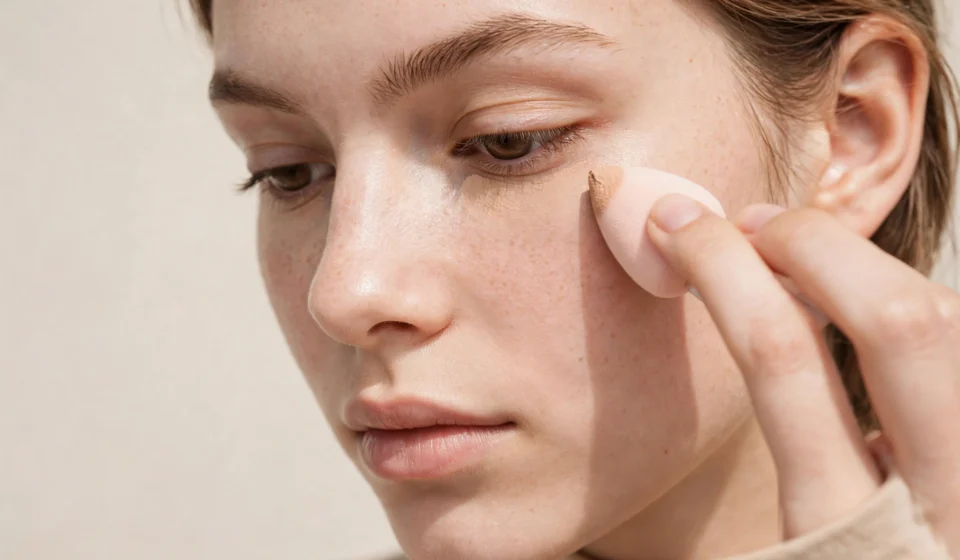
Blend with a damp makeup sponge, not your fingers and not a dry brush. A damp sponge presses the product into the skin instead of dragging it across the surface, and it picks up excess so you never end up with more than you need. Bounce the sponge — do not sweep or wipe. Sweeping moves the foundation and concealer underneath and creates the patchiness you are trying to avoid.
Then let it sit. After blending, wait 30 to 60 seconds before you set it with powder. That pause lets the concealer grip the skin and start to set on its own. Setting wet concealer traps moisture underneath the powder, and the whole thing breaks apart within a couple of hours. Patience here is worth more than any product.
The 5 Steps That Make Concealer Last All Day
Here is the whole routine in order. Follow these five steps exactly, and your concealer will hold from morning to night.
- Prep and wait. Cleanse, moisturise lightly, and wait two to three minutes. Apply a thin layer of primer where you need grip, and wait a full 60 seconds before the next step.
- Dot, do not swipe. Place tiny dots of concealer only where you need coverage — inner eye corner, blemish, redness — and nowhere else.
- Blend with a damp sponge. Bounce a damp sponge over the dots until the edges disappear. Add a second thin layer only in the centre if you still need more coverage.
- Let it sit, then set. Wait 30 to 60 seconds, then press a light layer of translucent setting powder over the concealer with a powder puff or dense brush. Press and roll — never sweep.
- Mist to lock it in. Hold setting spray 8 to 10 inches from your face and mist lightly in an X and a T pattern. Let it dry untouched for a minute before you touch your face or put on sunglasses.
That is the entire system. Steps one and four are where most people go wrong, and step five is the one people skip — but all five together are what take you from a 4-hour concealer to a 12-hour one.
How to Make Concealer Last All Day 2026: Set It So It Stays Put
Setting is where long wear is won or lost, and the details matter more than the products. After your concealer has had its 30 to 60 seconds to settle, take a small amount of translucent setting powder on a powder puff or a dense brush. Press it gently onto the concealed areas — under the eyes, around the nose, on any blemish — and nowhere else. Powder on dry cheeks or the forehead makes the base look dry and cakey by the afternoon, and it does nothing for wear time where there is no oil to control.
Press and roll the powder in; sweeping just pushes your concealer around. For areas that crease, like under the eyes and smile lines, use the baking technique: apply a generous amount of powder, let it sit for 5 to 10 minutes while you finish the rest of your makeup, then dust off the excess with a fluffy brush. Baking keeps concealer from settling into fine lines, but use it only where you crease — baking the whole face dries everything out.
Then comes the setting spray sandwich, the trick that changed how long my makeup lasts. Mist your face lightly with setting spray after primer, then again at the very end of your routine. Think of it as sandwiching your makeup between two thin layers of protection. The first mist helps the concealer grip; the final mist seals it. Hold the bottle 8 to 10 inches away, close your eyes, and mist in an X and a T so the coverage is even. Let it dry completely — do not fan it, do not touch it.
One caution: not all setting sprays are equal. A dewy or hydrating spray looks beautiful but will not extend wear the way a long-wear or matte setting spray does. If longevity is your goal, pick the bottle that says long-lasting or 16-hour wear, and save the dewy mist for days when you do not need the extra hours.
Best Concealer Types Compared
The table below compares the main concealer formats so you can pick the one that fits your skin and your day.
| Concealer Type | Best For | Wear Time | Finish | Watch Out For |
|---|---|---|---|---|
| Long-wear liquid | Oily skin, long days, events | 10–12 hours | Matte to satin | Can look dry on dry skin |
| Hydrating liquid | Dry skin, mature skin, under-eyes | 6–8 hours | Satin, radiant | Needs powder to last |
| Cream stick | Spot-concealing blemishes | 8–10 hours | Natural matte | Can drag if applied dry |
| Cream pot | Full coverage, discolouration | 8–10 hours | Full matte | Thick — thin layers only |
| Colour corrector | Dark circles, redness, dullness | 6–8 hours | Varies | Must be layered under concealer |
If you are buying one concealer for all-day wear, a long-wear liquid is the safest choice for most skin types — it is the easiest to apply thinly, the easiest to set, and the most forgiving across seasons. Keep a hydrating liquid as your second bottle for dry winter days or for under-eye use only.
Mistakes That Kill Your Concealer by Noon
Some habits quietly destroy wear time, and most of them feel like they should help. Applying concealer before foundation is the first: foundation on top moves the concealer underneath and thins it out unevenly. Always do foundation first, then spot-conceal only where coverage is still needed. You will use less product and get better wear.
Skipping powder is the second. Even the best long-wear concealer needs powder to lock it in, especially under the eyes. Without it, your own skin oils start breaking the formula down within two hours.
Touching your face is the third. Every time you rest your chin on your hand or rub your eyes, you lift product off. On long days, keep your hands away and blot instead of rubbing when oil appears.
Using expired or separated product is the fourth — if your concealer has changed smell, texture, or colour, it will not perform the way it used to, and no technique will save it.
Source American Academy of Dermatology – When to toss your makeup and sunscreen.
And finally, the wrong powder shade. A tinted powder that is too dark or too yellow can change the colour of your concealer as it wears, making it look muddy by the afternoon. Translucent powder avoids this entirely, which is why makeup artists reach for it first.
Concealer Wear for Every Skin Type and Season
Oily skin needs the most help, and it gets it from the full system: mattifying primer, long-wear matte formula, thin layers, powder, and a long-wear setting spray. Blotting papers in your bag are worth more than a touch-up compact — blot first, then add a tiny amount of powder if you need it, never more concealer on top of oil.
Dry skin needs the opposite emphasis: rich prep the night before, a hydrating formula, minimal powder pressed only where you crease, and a hydrating setting spray to finish. If your under-eyes look crepey by afternoon, the problem is almost always too much powder, not too little concealer.
Combination skin is a mix-and-match job — matte primer and powder on the T-zone and under the eyes, hydrating formula on dry cheeks. Treat each zone as its own canvas.
In summer heat and humidity, switch to the lightest formula you can get away with and lean on setting spray instead of powder, because heavy powder plus sweat equals cake. In winter, add the overnight eye cream and skip the baking step. And for a long event — a wedding, a full workday plus dinner — do the full five-step routine in the morning and carry only blotting paper and a small powder puff for the day. A midday top-up of concealer over oil and powder almost always looks worse than leaving it alone.
Quick Touch-Ups That Do Not Ruin Your Base
If your concealer does start to fade, resist the urge to pile more on top. First, blot away oil with a blotting paper or a clean tissue — press, do not rub. Then, if there is creasing under the eyes, tap the creased line gently with a clean fingertip or a damp sponge to smooth it back out; the warmth of your finger re-melts the product just enough to re-blend it. Only then, if you still need coverage, dot the tiniest amount of concealer into the centre of the area and blend the edges. Finish with a whisper of powder pressed on with a puff.
That order — blot, smooth, then add — is the difference between a touch-up that looks fresh and one that looks like a second layer of makeup sitting on top of the first. One careful touch-up at midday is all most people need; more than that usually means the morning routine needs adjusting, not the product.
Frequently Asked Questions
How long should concealer last?
A good long-wear concealer, applied in thin layers and set with powder and setting spray, should last 10 to 12 hours. A hydrating formula without setting will usually last 6 to 8 hours. If yours fades in under four hours, the cause is usually too much product, skipped powder, or a formula that does not suit your skin type.
Why does my concealer crease under my eyes?
Concealer creases under the eyes because the skin there moves constantly when you blink and smile, and because too much product collects in fine lines. Use less product, blend with a damp sponge, let it sit for 30 to 60 seconds, and press translucent powder over it before it has a chance to settle into lines. Baking the under-eye area for 5 to 10 minutes also helps.
Should I apply concealer before or after foundation?
Apply concealer after foundation. Foundation first evens out your skin tone, so you can see exactly where you still need coverage, and you will use far less concealer. Putting concealer on first means the foundation drags it around and thins it unevenly.
Does setting spray really make concealer last longer?
Yes — a long-wear setting spray forms a light film over your makeup that resists oil, friction, and humidity. Mist lightly from 8 to 10 inches away after your makeup is complete, and let it dry untouched. For the best result, mist once after primer and once at the end, which sandwiches the concealer between two protective layers.
Can I make concealer last all day without powder?
You can get close with a long-wear formula and setting spray, but powder is what absorbs the oil that breaks concealer down, so skipping it usually costs you two to three hours of wear. If you hate the feel of powder, use the smallest amount possible — press a whisper of translucent powder only onto the concealed areas with a puff, and nowhere else.
The Bottom Line
Making concealer last all day is not about one miracle product. It is about the system: hydrated, patiently prepped skin; the right formula for your skin type; thin layers blended with a damp sponge; a 30 to 60 second pause; powder pressed in, never swept; and a final mist of long-wear setting spray. Get those steps right and your concealer will look at 9 p.m. the way it looked at 9 a.m. — and you will have used less product to do it.
Try the full five-step routine tomorrow morning and see the difference for yourself. And if you want your whole base to last as long as your concealer, read our guide on how to make foundation last all day for the matching routine — the two together are the reason my makeup finally survives a full day.