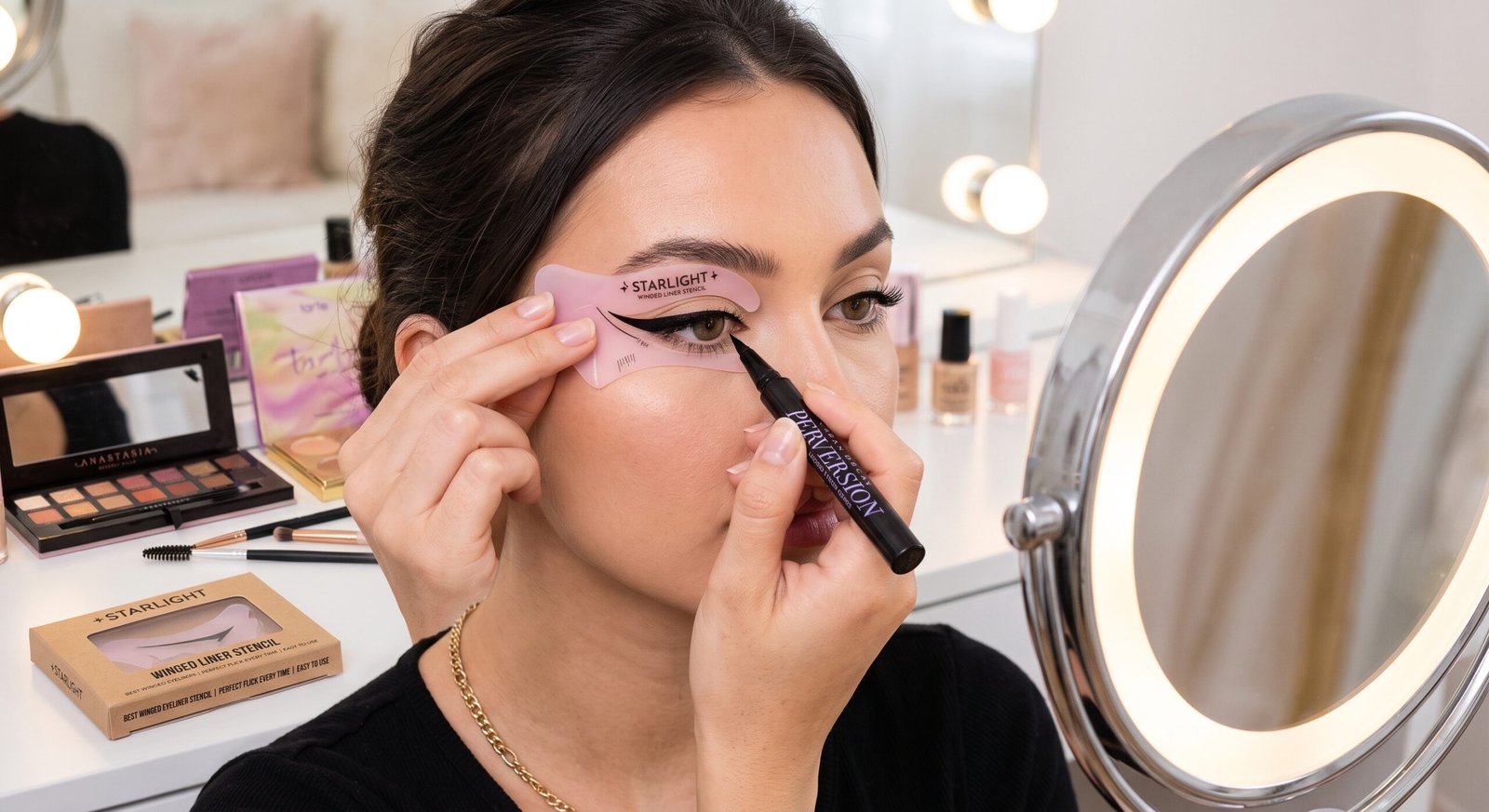

Getting a perfectly even winged eyeliner can be one of the trickiest parts of a makeup routine. One eye may look sharp and lifted while the other wing suddenly appears thicker, shorter, or pointed in a completely different direction. This is exactly where the best winged eyeliner stencil can make a difference.
An eyeliner stencil provides a guide that helps you create a cleaner wing without having to rely entirely on freehand application. It can be especially useful for beginners, makeup lovers with unsteady hands, or anyone who wants symmetrical cat-eye makeup without spending several minutes correcting each side.
In this guide, we’ll explain what a winged eyeliner stencil is, how to choose one, how to use it, which features matter, and how to create a polished wing for different eye shapes.
What Is a Winged Eyeliner Stencil?
A winged eyeliner stencil is a small makeup tool designed to guide the shape of your eyeliner wing. Instead of drawing the entire flick freehand, you position the stencil near the outer corner of your eye and fill or trace the opening with eyeliner.
The basic idea is simple:
Position → Fill → Remove → Connect → Refine
Major beauty publications and makeup brands have recommended stencil-style tools as an option for people who struggle with creating an even wing. L’Oréal Paris, for example, explains that a stencil can help create similarly shaped wings on both eyes.
Unlike a winged eyeliner stamp, a traditional stencil usually lets you choose the eyeliner formula and color yourself.
Why Use a Winged Eyeliner Stencil?
Winged eyeliner requires control, precision, and symmetry. A stencil reduces some of the guesswork by giving you a predefined outline.
Main Benefits
- Helps create a consistent wing shape
- Can be easier for beginners
- Reduces the need for repeated corrections
- Works with different eyeliner colors
- Can help improve symmetry
- Useful for creating classic cat-eye makeup
- Can save time during a busy makeup routine
- Allows you to practice your eyeliner technique
Makeup.com has highlighted eyeliner guides and stencils as useful tools for creating winged looks, while also noting that different tools can suit different application preferences.
Best Winged Eyeliner Stencil: What Should You Look For?
Not every stencil will work equally well for every person. The shape of your eye, amount of eyelid space, desired wing size, and eyeliner formula can all influence your experience.
Before choosing a stencil, consider these features.
1. Flexible Material
A flexible stencil can sit more comfortably against the curves around your eye.
Rigid plastic may work for some users, but a tool that does not sit properly against the skin can make the application more difficult.
2. Comfortable Size
A stencil should be large enough to hold securely but not so large that it becomes difficult to position.
A compact design is particularly useful if you travel frequently or keep your makeup collection small.
3. Multiple Wing Shapes
Some stencil kits include several shapes or angles.
This can be useful if you like switching between:
- Small everyday wings
- Classic cat eyes
- Dramatic wings
- Soft lifted flicks
- Graphic eyeliner
4. Easy-to-Clean Surface
Reusable stencils should be cleaned according to the manufacturer’s instructions.
A surface that is easy to clean is more convenient for regular use.
5. Suitable for Your Eye Shape
Eye shapes vary considerably. A stencil designed around one particular wing angle may not produce the same result on every person.
A good stencil should be treated as a guide rather than a guarantee of an identical result on every eye.
Winged Eyeliner Stencil vs. Eyeliner Stamp
Stencils and stamps are often confused, but they work differently.
| Feature | Eyeliner Stencil | Eyeliner Stamp |
|---|---|---|
| Application | Fill or trace the stencil | Press stamp onto skin |
| Color flexibility | Usually high | Depends on product |
| Wing shape | Can be customized | Predetermined |
| Beginner-friendly | Yes | Yes |
| Precision | Depends on placement | Depends on stamp alignment |
| Customization | More flexible | More limited |
| Best for | Learning and customizing | Fast application |
L’Oréal Paris describes a stencil as a guide that you fill with your chosen eyeliner, while a stamp transfers a pre-shaped wing directly onto the skin.
How to Use a Winged Eyeliner Stencil
Using a stencil is relatively simple, but positioning is important.
Step 1: Prepare Your Eyelid
Start with clean, dry skin.
If you have oily eyelids, applying your normal eye makeup base can help create a smoother surface for eyeliner.
Step 2: Complete Your Eyeshadow First
If you’re wearing eyeshadow, complete the eyeshadow look before applying the final eyeliner.
This prevents you from accidentally covering or disturbing the wing while blending shadow.
Step 3: Position the Stencil
Place the stencil near the outer corner of your eye.
Angle it according to the wing style you want.
For a classic lifted look, many people follow the general direction of the lower lash line rather than choosing an entirely random angle.
Step 4: Hold It Firmly
Keep the stencil flat against the skin.
Movement during application can create gaps or uneven edges.
Step 5: Fill the Opening
Use a liquid, gel, or pencil eyeliner to fill the stencil opening.
A fine-tip product usually gives you better control around a small stencil.
Step 6: Remove the Stencil Carefully
Lift the stencil away from the skin without dragging it across the eyeliner.
You should now have the basic wing shape.
Step 7: Connect the Wing
Connect the wing to your upper lash line using small, controlled strokes.
Step 8: Refine the Shape
If necessary, use a small amount of concealer or makeup remover on a precision brush or cotton swab to clean the edges.
L’Oréal’s current tutorial similarly recommends positioning the stencil flat, filling the opening, removing it carefully, and then completing the eyeliner connection.
Best Winged Eyeliner Stencil for Beginners
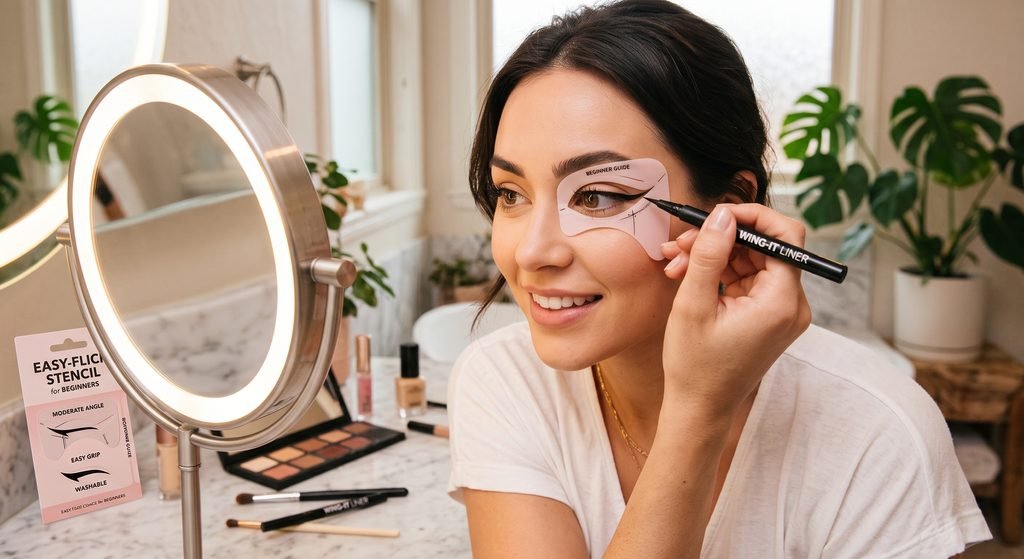
If you’re new to winged eyeliner, look for a stencil that:
- Has clear edges
- Is easy to hold
- Offers a moderate wing angle
- Does not require complicated positioning
- Can be used with your preferred eyeliner
- Is easy to clean
A simple design may actually be easier to learn with than a kit containing dozens of complicated shapes.
Think of the stencil as training wheels for eyeliner. With regular practice, you may eventually become comfortable drawing the shape without a guide.
L’Oréal Paris specifically describes stencils as a useful learning tool for people who want to improve their winged-eyeliner technique.
Best Winged Eyeliner Stencil for Hooded Eyes
Hooded eyes can require more customization because part of the eyelid may be covered when the eyes are open.
A fixed stencil may not always fit perfectly.
When using a stencil on hooded eyes:
- Keep your eyes relaxed.
- Check the stencil position before applying liner.
- Avoid placing the wing too far into the crease.
- Adjust the angle if necessary.
- Look straight ahead before removing the stencil.
- Refine the line after the stencil is removed.
The goal is not to copy a wing shape exactly from another person. Your stencil should help you create a shape that works with your own eye structure.
Best Winged Eyeliner Stencil for Almond Eyes
Almond eyes generally provide a versatile canvas for winged eyeliner.
You can experiment with:
- Thin micro wings
- Classic cat eyes
- Longer dramatic wings
- Smoky wings
- Colored eyeliner
A stencil with multiple wing sizes can be useful if you like changing your makeup style.
Best Winged Eyeliner Stencil for Round Eyes
If you have round eyes, a longer outward wing can create a more elongated visual effect.
Rather than making the wing extremely thick, try keeping the inner line relatively thin and gradually increasing the thickness toward the outer corner.
Best Winged Eyeliner Stencil for Downturned Eyes
For downturned eyes, consider experimenting with a slightly more lifted wing angle.
Avoid automatically following the downward direction of the outer corner.
Instead, position the stencil slightly upward and check the result with your eyes open before filling it completely.
Best Eyeliner Formula to Use With a Stencil
Your stencil is only part of the equation. The eyeliner formula also matters.
Liquid Eyeliner
Liquid liner is a popular choice for crisp, defined wings.
A fine brush or precision felt tip can help fill the stencil opening accurately.
Gel Eyeliner
Gel liner can create a richer, softer appearance while still allowing precise application.
It can be particularly useful if you prefer a slightly less sharp finish.
Pencil Eyeliner
Pencil can create a softer wing and is often easier for beginners to control.
However, some softer formulas may not produce the ultra-sharp edges associated with liquid liner.
How to Make Your Winged Eyeliner Look More Natural
Not every wing needs to be dramatic.
For an everyday makeup look:
- Use a thin eyeliner line.
- Choose a small stencil opening.
- Keep the wing relatively short.
- Use brown eyeliner for a softer appearance.
- Blend the outer edge slightly if desired.
For evening makeup, you can increase the thickness and length of the wing.
Common Winged Eyeliner Stencil Mistakes
Even with a stencil, a few mistakes can affect the final result.
Using Too Much Eyeliner
Heavy product can bleed underneath the stencil and blur the edge.
Use controlled strokes and avoid flooding the stencil opening.
Moving the Stencil
If the stencil shifts while you are filling it, the wing may become uneven.
Hold it securely against the skin.
Using the Same Angle Automatically
Your eye shape may require a slightly different angle.
Don’t assume one universal wing shape works perfectly for everyone.
Ignoring the Lash Line
A beautiful wing can look disconnected if it isn’t properly connected to the upper lash line.
Always check the transition between the wing and your liner.
Making Both Wings Identical Instead of Balanced
Eyes naturally have small differences.
Instead of obsessing over mathematically identical wings, focus on creating a balanced appearance when both eyes are open.
Stencil vs. Freehand Eyeliner
A stencil isn’t necessarily better than freehand eyeliner. They simply offer different approaches.
Stencil application can be useful when you want guidance and consistency.
Freehand application gives you more freedom to customize the wing’s exact shape and thickness.
If you’re learning, starting with a stencil can help you understand the basic angle and proportions. With practice, you can gradually experiment without it.
How to Clean a Reusable Eyeliner Stencil
If you are using a reusable stencil, cleaning it is important.
After use:
- Remove visible eyeliner residue.
- Follow the manufacturer’s cleaning instructions.
- Use a suitable makeup-cleaning method for the material.
- Allow the stencil to dry completely.
- Store it in a clean place.
Don’t share eye makeup tools without proper cleaning, especially when they come into contact with the eye area.
Can an Eyeliner Stencil Really Create Perfect Wings?
A stencil can make the process easier, but it cannot guarantee perfection.
The final result depends on:
- Stencil placement
- Eye shape
- Eyeliner formula
- Amount of product
- Hand control
- Lid texture
- Desired wing style
The stencil provides the outline. You still control the application.
This is why practicing with a stencil can be useful even if your long-term goal is to master freehand eyeliner.
Frequently Asked Questions
What is the best winged eyeliner stencil?
The best stencil depends on your eye shape, preferred wing size, eyeliner formula, and experience level. A flexible, easy-to-position stencil with a clear opening is generally a practical starting point for beginners.
Do eyeliner stencils really work?
Yes. A stencil can provide a physical guide for creating the wing. However, correct placement and careful application are still important.
Are winged eyeliner stencils good for beginners?
Yes. They can reduce the difficulty of drawing a symmetrical wing and can also help beginners learn the basic shape and angle.
Can I use a stencil with pencil eyeliner?
Yes. You can generally use a stencil with pencil, gel, or liquid eyeliner, provided the product works well with the stencil material and the manufacturer’s instructions allow it.
Are eyeliner stamps better than stencils?
They serve different purposes. A stamp can be faster because it transfers a pre-shaped wing, while a stencil gives you more control over the eyeliner color and application.
Which eyeliner is easiest for winged eyeliner?
A fine-tip liquid or felt-tip eyeliner can be easier for creating sharp lines, while pencil and gel formulas may be preferable for softer or more forgiving looks.
Can I use an eyeliner stencil with hooded eyes?
Yes, but you may need to adjust the angle and placement. A fixed stencil may require more customization on hooded eyes because the crease can affect the visible shape.
How do I keep both eyeliner wings even?
Use the same reference point and angle on both eyes, apply similar pressure, and compare both wings before making them thicker. A stencil can help provide a consistent starting shape.
Final Thoughts
Finding the best winged eyeliner stencil can make one of the most challenging parts of eye makeup feel much more manageable. Instead of trying to draw a perfect flick entirely freehand, you can use a stencil to establish the basic shape and then customize the final look.
For beginners, a simple and flexible stencil is a good place to start. If you have hooded, round, almond, or downturned eyes, experiment with the angle rather than assuming one stencil position will work perfectly.
The most important thing is to remember that a stencil is a guide, not a magic solution. With the right eyeliner, careful placement, and a little practice, you can create everything from a subtle everyday flick to a dramatic cat-eye look.