
Table of Contents
You spray your favourite perfume at 8 in the morning, step out feeling wonderful — and by lunchtime, it is gone. Not faded a little. Gone. You lean into your wrist, sniff, and smell nothing but skin. If that sounds familiar, you are not imagining it, and you are definitely not alone: most perfume fades far faster than it should, not because the bottle is bad, but because of how it is applied. This guide on how to make perfume last longer will show you the exact routine that keeps a scent on your skin from morning to evening — the same kind of “last all day” routine this series has already covered for lipstick, eyeshadow, blush, eyeliner, foundation, lip gloss, mascara and nail polish. Perfume is the newest product category in the series, and the rules are simpler than you think: moisturise first, spray the right spots, never rub your wrists, and choose the right concentration.
Here is the honest truth most perfume counters will not tell you: a perfume’s lasting power is decided before you ever press the sprayer. Dry skin lets fragrance molecules evaporate in an hour or two, while moisturised skin holds them for six to eight. The concentration printed on the bottle matters just as much — an eau de parfum carries roughly twice the fragrance oil of an eau de toilette, and that difference is the difference between a scent that survives the workday and one that gives up by noon. Add in the right pulse points, the right number of sprays, and proper storage, and a single bottle suddenly lasts twice as long on your skin. Every tip below is free or nearly free, takes seconds to apply, and works with the perfume you already own. No new bottle required.
Quick Answer: How to Make Perfume Last Longer
The fastest way to make perfume last longer is to moisturise your skin first with an unscented lotion, then spray two to three times on warm pulse points — wrists, neck, behind the ears — and let the scent dry naturally without rubbing your wrists together. Choose an eau de parfum (EDP) over an eau de toilette (EDT) for all-day wear, because EDP contains 15 to 20 percent fragrance oil and lasts six to eight hours, while EDT fades in three to four. Spray right after a warm shower, when your skin is clean and slightly damp, and store the bottle in a cool, dark place — never in a steamy bathroom. If your scent fades by afternoon, one refresh spray on a single pulse point is enough.
- Moisturise first — hydrated skin holds fragrance molecules far longer than dry skin; this one step can double your wear time.
- Spray pulse points only — wrists, neck, behind the ears, inner elbows and behind the knees, where body heat gently lifts the scent all day.
- Never rub your wrists together — rubbing creates friction and heat that breaks down the top notes and makes the scent fade faster.
- Choose EDP over EDT — eau de parfum has 15 to 20 percent fragrance oil and lasts six to eight hours; eau de toilette has 5 to 15 percent and fades in three to four.
- Store it cool and dark — heat, humidity and sunlight degrade fragrance over time, so keep bottles out of the bathroom.
Make it last in 5 steps:
- Step out of a warm shower, pat your skin dry, and smooth an unscented lotion over your pulse points. Wait a minute for it to sink in.
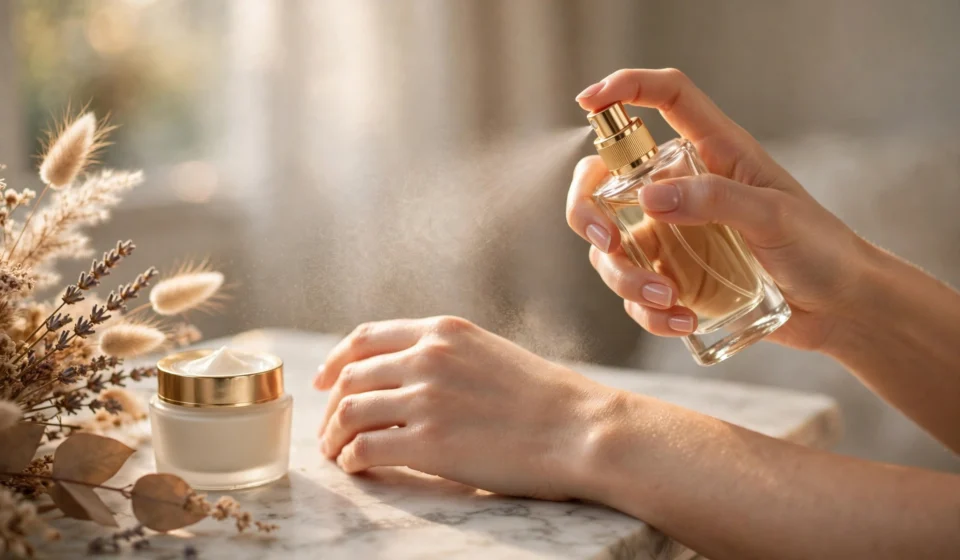
- Hold the bottle 15 to 20 centimetres from your skin and spray two to three times on pulse points — wrists, neck, behind the ears.
- Let the perfume dry naturally on your skin. Do not rub your wrists together and do not wave your arms to dry it.
- If you want extra staying power, spray once on your clothes or the ends of your hair from a distance — fabric holds scent far longer than skin.
- Store the bottle in a cool, dark drawer, and refresh with one spray on a single pulse point in the afternoon if needed.
| Concentration | Fragrance Oil | Typical Wear Time | Best For |
|---|---|---|---|
| Parfum / Extrait de Parfum | 20% or more | 8–12+ hours | Special occasions, all-day events |
| Eau de Parfum (EDP) | 15–20% | 6–8 hours | All-day wear, evenings, workdays |
| Eau de Toilette (EDT) | 5–15% | 3–4 hours | Daytime, warm weather, light wear |
| Eau de Cologne (EDC) | 2–4% | 1–2 hours | A quick fresh spritz |
| Body Mist | 1–3% | 1–2 hours | Layering, casual wear, refreshing |
Why Does Perfume Fade So Fast?
Before you fix the problem, it helps to know what is actually happening on your skin, because perfume does not simply “wear off” — it evaporates in layers, and each layer disappears at a different speed. A fragrance is built in three stages: top notes, the bright first impression you smell in the first fifteen minutes; heart notes, the character of the scent that emerges over the next few hours; and base notes, the deep, heavy molecules — musk, amber, vanilla, sandalwood, oud — that linger longest. The top notes are the lightest molecules and the first to leave. The base notes are the heaviest and the last to go. That is why a perfume smells different at 9 am than it does at 3 pm, and why a scent built on rich base notes will always outlast a light citrus one, even in the same concentration.
Three things decide how fast those layers leave your skin. The first is concentration: the percentage of pure fragrance oil in the bottle. More oil means more scent molecules on your skin, and more time before they are all gone — which is why an EDP outlasts an EDT by hours. The second is your skin. Dry skin is perfume’s worst enemy: fragrance molecules have nothing to cling to, so they evaporate quickly, and the scent can vanish in two hours. Oily or well-moisturised skin holds the same molecules for far longer, because the oils and creams on the surface give the fragrance something to bind to. The third is where and how you apply it. Spraying into the air and walking through it wastes most of the bottle on the room. Rubbing your wrists together crushes the top notes before they ever get to develop. Spraying on cold skin, or on top of a strongly scented lotion that fights with your perfume, shortens the wear time too. Fix these three things — concentration, skin prep, and application — and the same bottle will last hours longer on you.
Tip 1: Moisturise First — The Single Biggest Fix
If you take only one tip from this entire guide, take this one: moisturise before you spray. It is the simplest change in the guide and the one with the biggest effect, because hydrated skin holds fragrance molecules far longer than dry skin. Think of it this way: perfume oil needs something to hold on to. On dry skin, there is nothing — the molecules sit on a bare surface and evaporate into the air within an hour or two. On moisturised skin, the lotion gives them a base to cling to, and the scent releases slowly over hours instead of disappearing at once. Every major fragrance guide agrees on this point, and it is the reason perfumers themselves apply perfume after moisturising, never before.
The method matters. Apply an unscented body lotion or cream to the areas you plan to spray — wrists, neck, inner elbows, behind the knees — and give it a minute to sink in before you reach for the bottle. Unscented matters because a strongly scented lotion will compete with your perfume and change how it smells; a matching scented body lotion from the same fragrance line is the one exception, and it works even better than unscented, because it layers the same scent underneath the spray. If your skin is very dry, a richer option works even better: a small dab of petroleum jelly or a fragrance-free balm on your pulse points before spraying creates a slightly sticky base that traps fragrance molecules and slows evaporation dramatically. It takes three seconds, it costs almost nothing, and it can add hours to a perfume’s life on your skin. The best time to do all of this is right after a warm shower, when your skin is clean, warm and slightly damp — the moisture in the air has already hydrated the surface, and the lotion locks it in.
Tip 2: Spray Pulse Points, Not the Air
Where you spray matters as much as what you spray. The best spots are your pulse points — the places where your arteries run close to the surface and your body gives off gentle warmth all day. That warmth is what lifts the scent off your skin and into the air around you, slowly and steadily, instead of letting it evaporate in one burst. The classic pulse points are the insides of your wrists, the base of your throat, behind your ears, the insides of your elbows, and behind your knees. You do not need to cover all of them. Two or three spray zones are enough for everyday wear — pick the wrists and neck, or the neck and behind the ears, and let the scent do its work from there.
Hold the bottle 15 to 20 centimetres — about six to eight inches — from your skin, and spray so the fragrance lands as a light, even mist rather than a wet patch. Spraying too close floods one spot and wastes the bottle; spraying from the right distance gives an even coat that dries properly. And skip the famous “spray and walk through the cloud” trick: it looks elegant in films, but most of the perfume lands on the floor and your clothes get only a faint dusting. Direct application to warm skin is far more effective. One spot most people forget is behind the knees — it sounds odd, but the warmth there rises through the day as you move, and it is one of the best places for a scent that keeps revealing itself hours after you applied it. For the same reason, the inner elbows are a quiet favourite among fragrance lovers: the skin is thin, the area is warm, and the scent projects gently every time you bend your arm.
Tip 3: Don’t Rub Your Wrists Together
This is the most consistent piece of advice from perfumers, and the most consistently ignored. After spraying your wrists, do not rub them together. It feels natural — almost automatic — but the friction creates heat, and that heat breaks down the fragrance molecules in the top notes faster than they would naturally evolve. The result is a scent that smells flatter, develops wrong, and fades sooner than it should. The top notes are the most delicate part of a perfume, and rubbing crushes them before they have had a chance to settle on your skin.
Instead, let the perfume dry naturally. Spray, lower your arms, and leave your wrists alone for a minute. The scent will settle on its own, and it will smell the way the perfumer intended it to smell. The same rule applies to any spot you spray: do not press your neck after spraying it, do not rub behind your ears, and do not wave your arms to dry the scent faster. Air-drying is part of how a fragrance develops — the alcohol base evaporates first, and then the notes unfold in their proper order. Rushing that process only shortens it. If you have been rubbing your wrists together for years, breaking the habit alone can add a noticeable hour or two to how long your perfume lasts, and it costs you nothing at all.
Tip 4: Choose EDP Over EDT for All-Day Wear
If your perfume fades by noon no matter what you do, the bottle itself may be the problem — not your technique. The concentration printed on the bottle is the single clearest signal of how long a scent will last, and most people buy the lighter version without realising it. An eau de parfum (EDP) contains 15 to 20 percent fragrance oil and typically lasts six to eight hours on moisturised skin. An eau de toilette (EDT) contains 5 to 15 percent and usually fades in three to four hours. That is not a small difference — it is the difference between reapplying at lunch and not thinking about your perfume again until evening.
Check the label before your next purchase: the concentration is usually printed in small type on the front or back of the box, and many bottles say “Eau de Parfum” or “Eau de Toilette” right under the fragrance name. If you love a scent that only comes as an EDT, you can still make it work — moisturise first, spray on pulse points and clothes, and carry a travel spray for a midday refresh — but know that you are starting from a shorter baseline. For all-day wear, an EDP built on heavy base notes is the strongest choice: look for amber, vanilla, sandalwood, musk, patchouli or oud in the base, because those are the heaviest molecules in a fragrance and the ones that stay on skin long after the top notes have gone. A light citrus EDT, by contrast, is built to be fresh and fleeting — lovely for a summer morning, but never going to survive until dinner, no matter how perfectly you apply it.
Tip 5: Spray Clothes and Hair the Right Way
Skin is warm, and warmth makes fragrance evaporate — which is exactly why perfume fades faster on skin than on fabric. Clothes do not generate heat, so scent molecules sit on the fibres and release slowly for hours longer than they would on your wrist. One spray on your scarf, the collar of your shirt, or the inside of your jacket can still be noticeable the next morning. That makes clothing the single best trick for a scent that needs to survive a full day: spray your pulse points for the way the fragrance develops on your skin, and add one spray to fabric for the staying power.
There are two cautions. First, perfume can stain delicate fabrics, especially silk, light colours and leather, because the oils and the alcohol base can leave marks. Spray from a distance — 20 centimetres or more — and test on an inside seam first if the garment matters to you. Darker, sturdier fabrics are the safest bet. Second, hair holds scent beautifully but alcohol-based perfume can dry it out, so never spray directly onto dry hair from close range. Instead, spray once into the air in front of you and walk through it — this is the one time the cloud trick is correct — or spray a hairbrush lightly and run it through the ends of your hair. The scent will follow you for hours, and your hair will not suffer. A light spritz on the ends after styling is enough; the heat from your head does the rest, lifting the scent gently all day.
Tip 6: Layer with Matching Products
Layering is the perfumer’s own trick for making a scent last, and it is simpler than it sounds. Many long-lasting fragrances are sold with matching body products — a shower gel, a body lotion, sometimes a body oil — all carrying the same scent. Using the matching scented body lotion before you spray builds a base of the same fragrance underneath the perfume, so the scent has two layers to draw on instead of one. The lotion’s version is lighter and sits closer to the skin; the spray sits on top and projects. Together, they last far longer than either one alone, and the scent stays truer, because nothing in the routine fights with the perfume’s own notes.
If your fragrance has no matching products, you can still layer with an unscented lotion or a fragrance-free body oil — the moisturising base is the part that matters most, and the scent layer on top does the rest. What you should not do is layer two different perfumes, or a strongly scented lotion from another fragrance family, on top of your perfume. The notes clash, the result smells muddled, and the stronger scent often kills the subtler one entirely. One fragrance, layered in the same family, beats two fragrances competing on the same skin. If you want to experiment with layering different scents, keep it to the same family — two warm ambers, or two clean musks — and test the combination at home first, not on the way to an event.
Tip 7: Apply After a Shower
The best time to apply perfume is right after a warm shower, and it is not a small difference. Warm water opens your pores, the steam hydrates the surface of your skin, and your body is at its warmest — all three things help a fragrance open up and settle properly. Apply your moisturiser first, let it sink in for a minute, and then spray while your skin is still slightly warm. The scent will bloom more fully than it does on cold, dry morning skin, and it will hold longer because the hydrated surface gives it something to grip.
There is one condition: your skin must be dry before you spray. Water on the surface dilutes the perfume and stops it bonding with your skin properly, so pat yourself dry first, moisturise, and then spray. The same logic applies in reverse — never spray perfume onto sweaty skin and expect it to last, because sweat and body heat push the fragrance off even faster than dry skin does. If you exercise in the morning, shower first and spray after. And if you are getting ready for an evening out, a quick warm shower before you dress is worth the effort for the scent alone: the same bottle, applied to warm post-shower skin instead of cold skin at the end of a long day, can easily last two or three hours longer.
Tip 8: Store Your Bottles Properly
A perfume that fades fast may not be your fault at all — it may be dying in the bottle. Fragrance is a delicate mixture of oils and alcohol, and three things destroy it over time: heat, humidity, and direct sunlight. A bottle kept on a sunny windowsill or on a bathroom shelf, where every hot shower fills the room with steam, will degrade in months. The top notes go first — the scent turns flat, sharp or faintly sour — and then the whole fragrance loses its staying power, because the oils that were supposed to linger have already broken down. That is why the most common storage spot in the house, the bathroom, is also the worst one.
The fix is simple: keep your bottles in a cool, dark place, away from radiators, windows and steam. A bedroom drawer, a wardrobe shelf, or a closed cupboard is ideal — stable temperature, no direct light, low humidity. Keep the cap on between uses, because the bottle is not airtight without it, and oxygen slowly degrades the fragrance too. Keep the bottle upright, and do not decant perfume into a clear container for display. Stored properly, a good perfume keeps its character for three to five years; stored badly, it can turn in under a year. If a bottle you once loved now smells weak or off, check where it has been living before you blame the brand — and replace it only after you have fixed the storage, or the new bottle will fade just as fast.
Tip 9: Refresh Smartly at Midday
Even with perfect technique, a lighter fragrance will fade by the afternoon — and that is normal, not a failure. The mistake is trying to fix it by re-spraying as much as you did in the morning. A full second application on top of the morning’s base is too much: the fresh spray sits on top of the faded one, the combination smells heavy and sharp, and everyone around you notices for the wrong reasons. The right refresh is small and targeted.
Carry a travel spray or a small decant in your bag, and in the early afternoon, apply one spray to a single pulse point — one wrist, or the base of your neck — and nothing else. That single spray revives the scent without overloading it, because the morning’s base notes are still there underneath, and the fresh top notes wake them up. One spray is genuinely enough: you are topping up a fading scent, not starting over. If you do not carry a travel spray, a scented hand cream or a dab of the matching body lotion on your wrists does the same job more discreetly. And if you find yourself needing a full reapplication every day, that is useful information — it means your fragrance’s concentration is too light for your needs, and your next bottle should be an EDP, not another EDT.
How Much Perfume Should You Spray?
Over-spraying is the other way to waste a good perfume. More sprays do not make a scent last proportionally longer — after a certain point, the extra fragrance just sits on the surface, smells overpowering for the first hour, and then fades at the same rate anyway. The right amount depends on the concentration and the occasion, and the table below is a reliable starting point. When in doubt, spray less: you stop noticing your own perfume after about twenty minutes because your nose adapts to it, a phenomenon called olfactory fatigue. The fact that you can no longer smell it does not mean everyone else cannot — it almost certainly means they still can.
| Occasion | EDP Sprays | EDT Sprays | Where |
|---|---|---|---|
| Office / workday | 2–3 | 3–4 | Wrists and neck only — keep it close to the skin |
| Daytime / errands | 2–3 | 3 | Wrists, neck, behind the ears |
| Evening / dinner out | 3–4 | 4–5 | Add inner elbows or behind the knees |
| Special occasion / event | 4–5 | 5 | Pulse points plus one spray on clothes |
| Hot weather | 1–2 | 2–3 | Less is more — heat amplifies projection |
Hot weather deserves a special note, because heat is the great amplifier of perfume. In summer, your skin is warmer, your pulse points are more active, and the same two sprays project twice as far as they would in winter. Spraying your usual winter amount in July will overwhelm a room. Cut back by a spray or two, choose lighter concentrations for the daytime, and save the heavy ambers and ouds for the evening. The reverse is true in winter: cold skin projects less, so you can afford one extra spray, and richer base notes earn their keep. For more routines in the same “last all day” series, see our guides on how to make nail polish last longer, how to make lip gloss last all day and how to make foundation last all day. For the science behind concentrations and application, read the detailed guides from Ulta Beauty and Scentbird.
Frequently Asked Questions About Making Perfume Last Longer
Why does my perfume fade so quickly?
Usually because your skin is dry, the concentration is too light, or you are rubbing your wrists together after spraying. Dry skin lets fragrance molecules evaporate in an hour or two, while moisturised skin holds them for six to eight. An eau de toilette also fades in three to four hours by design, while an eau de parfum lasts six to eight. Moisturise first, spray pulse points, let it dry naturally, and check whether your bottle is an EDT or an EDP.
Does moisturiser really make perfume last longer?
Yes, and it is the single most effective thing you can do. Hydrated skin gives fragrance molecules something to cling to, so the scent releases slowly over hours instead of evaporating at once. Apply an unscented lotion to your pulse points a minute before you spray, or use a matching scented body lotion from the same fragrance line for an even stronger effect. A dab of petroleum jelly on pulse points works the same way on very dry skin.
Should I spray perfume on my clothes or my skin?
Both, for different reasons. Skin is where a fragrance develops properly — the warmth opens up the notes in their intended order. Clothes hold scent far longer, because fabric does not generate heat, so one spray on a scarf or collar can still be noticeable the next day. Spray your pulse points first, then add one spray to fabric from a distance. Test on an inside seam first, because perfume can stain silk, light colours and leather.
How many sprays of perfume should I use?
Two to three sprays of an eau de parfum is right for most days — wrists and neck for the office, plus behind the ears for an evening out. Eau de toilette needs three to four because it is lighter. Hot weather needs fewer sprays, because heat amplifies projection. Remember that you stop noticing your own perfume after about twenty minutes, so the fact that you can no longer smell it does not mean it is gone.
Where should I store my perfume so it lasts?
In a cool, dark place — a bedroom drawer, a wardrobe shelf or a closed cupboard — away from radiators, windows and steam. Never store perfume in the bathroom, where heat and humidity degrade the fragrance, and never on a sunny windowsill. Keep the cap on between uses and the bottle upright. Stored properly, a good perfume keeps its character for three to five years.